
AI Will Not Transform the SDLC
Not Unless the SDLC Itself Changes
20 May 2026 | Kingsley Ijomah
Executive Summary
AI is rapidly becoming embedded in software delivery, but many organizations are applying it too narrowly. The most common starting point is code generation, which is useful, visible and easy to demonstrate. However, code generation alone does not address the deeper constraints that slow software delivery: unclear requirements, weak refinement, fragmented knowledge, manual feedback loops, slow review cycles and low trust in new ways of working.
For senior technology leaders, the strategic question is no longer whether AI can improve the software development lifecycle. It can. The more important question is how organizations migrate from a traditional SDLC to an AI-augmented one without undermining quality, culture or engineering confidence.
The winners will not be the organizations that mandate AI adoption fastest. They will be those that adopt it deliberately, transparently and progressively. They will start with low-risk, high-friction tasks. They will give engineers agency over how agents are introduced. They will measure cycle time, quality, review confidence and developer experience rather than vanity metrics such as lines of code generated. Most importantly, they will treat AI adoption as an operating model shift, not a tooling rollout.
The Revolution Has a Brochure.
The Migration Path Does Not.
There is no shortage of ambition around AI-driven software delivery. Major technology providers, consultancies and research organizations are publishing frameworks for the AI-enabled or agentic SDLC. The vision is compelling: faster release cycles, autonomous agents, engineers elevated into orchestration roles and software teams able to move from idea to production at unprecedented speed.
The direction of travel is broadly right. AI will change how software is planned, built, tested, reviewed and maintained. But most frameworks still understate the practical challenge facing enterprise technology leaders.
The issue is not the future-state vision. The issue is the migration path.
Most organizations are not starting from a clean slate. They are starting from complex estates, legacy platforms, stretched teams, fragmented knowledge, inconsistent documentation and delivery models already under pressure. Introducing AI into that environment is not simply a matter of deploying tools. It requires a careful redesign of how work flows through the SDLC.
This is where many AI adoption programs lose momentum. The technology may be capable, but the operating environment is not ready to absorb it. The result is often a gap between promise and performance. Teams experiment with AI assistants, see some local productivity gains, but struggle to translate those gains into faster delivery, better quality or measurable business value.
The hard part of AI-native development is not the AI. It is becoming native to a new way of working.
Start: AI Applied Only to Code Creates a Ceiling
Code Generation Is Useful, But It Is Not a Strategy
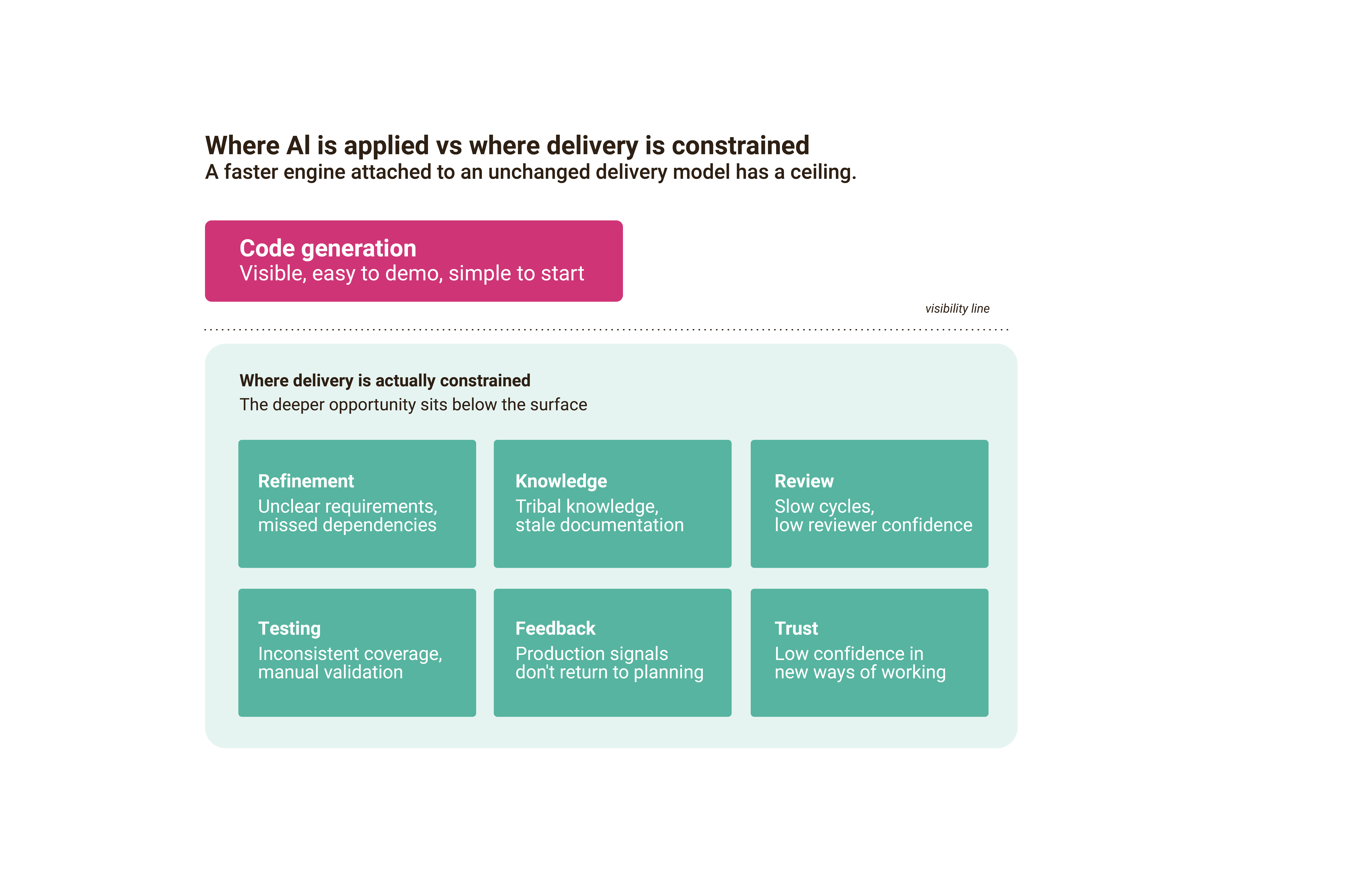
Most organizations begin their AI journey with code generation. This is understandable. It is highly visible, easy to demo and relatively simple for teams to experiment with. Engineers can see immediate benefits when AI assists with boilerplate, syntax, simple functions or repetitive implementation tasks.
However, code generation is only one part of software delivery. Improving the speed of code production does not automatically improve the speed of delivery. In many organizations, the real constraints sit elsewhere.
Requirements are incomplete. Stories are refined using assumptions rather than evidence. Dependencies are discovered too late. Code review becomes a bottleneck. Test coverage is inconsistent. Documentation is out of date. Teams rely heavily on tribal knowledge. Production feedback does not flow cleanly back into planning.
In this environment, faster code generation can actually expose deeper weaknesses in the SDLC. If teams generate code faster than they can understand, review, test and safely release it, the organisation has not increased delivery performance. It has increased throughput into an already constrained system.
AI applied only to coding is a faster engine attached to an unchanged delivery model.
The SDLC Does Not Need Replacing. It Needs Rewiring.
The traditional SDLC was designed around a core assumption: humans perform the implementation work. AI changes that assumption. Once agents can contribute to implementation, testing, documentation, analysis and refinement, the surrounding process needs to adapt.
This does not mean the SDLC becomes irrelevant. Discovery, design, development, testing, deployment and monitoring still matter. What changes is how intelligence, context and decision-making move through those stages.
The most valuable use of AI may not be writing more code. It may be improving the quality of the work before code is written and strengthening the feedback loops after code is produced.
For many enterprises, the biggest opportunity lies in the less glamorous parts of delivery: understanding how a system actually works before changing it; improving the quality of backlog items before sprint planning; surfacing dependencies before implementation starts; generating test coverage for areas teams avoid touching; creating documentation that reflects the current codebase; and helping reviewers understand proposed changes faster and with more confidence.
These are the areas where AI can begin to change delivery performance at a systemic level. They are also the areas most often overlooked when adoption is framed only around developer productivity.
Middle: The Real Barrier Is Trust, Context and Operating Model Change
The Adoption Trust Paradox
AI adoption in engineering teams creates a trust paradox.
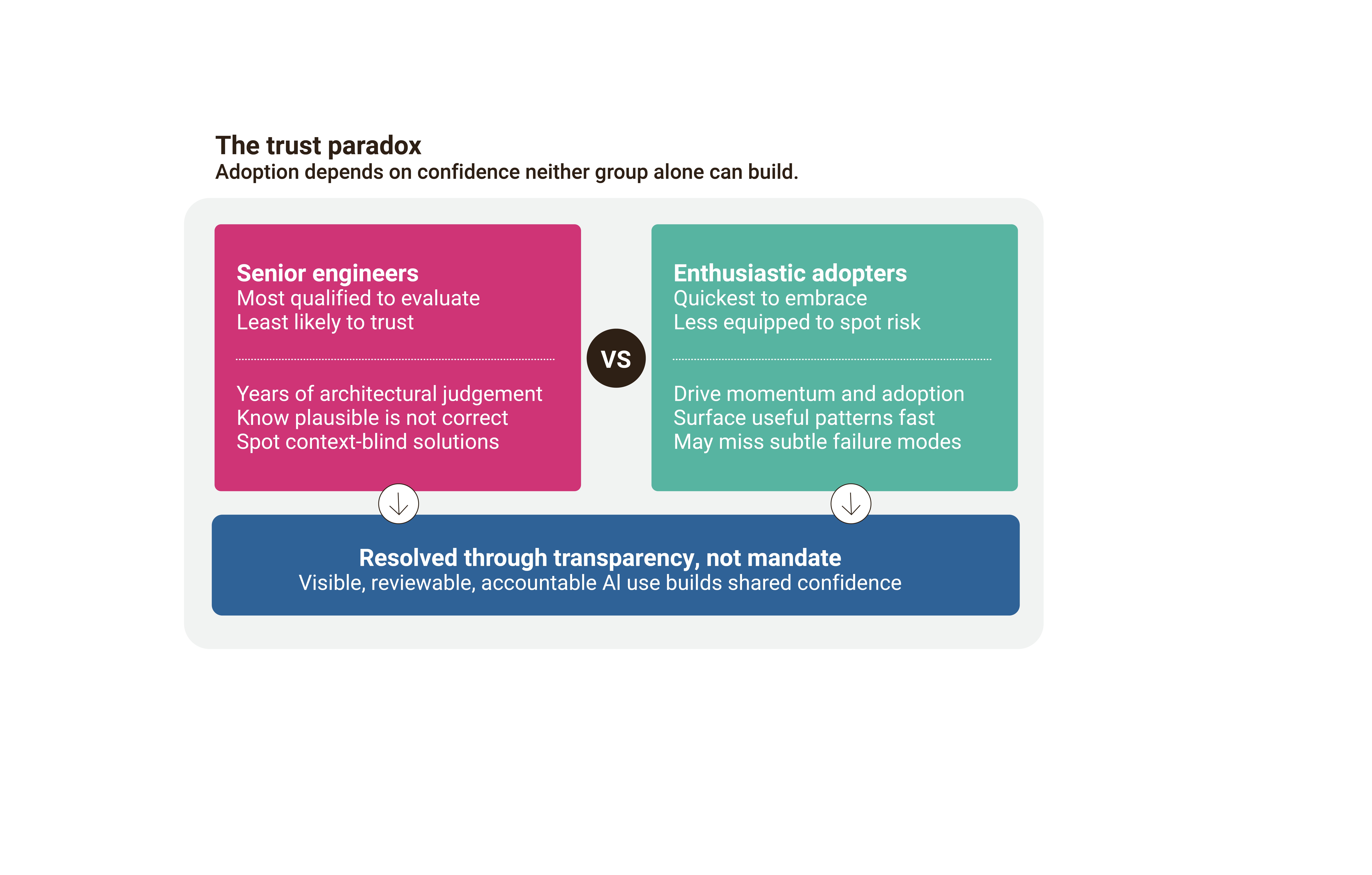
The engineers most qualified to evaluate AI output are often the least likely to trust it. They have spent years developing judgement, architectural discipline and an instinct for where systems fail. They know that plausible code is not the same as correct code. They understand that a solution can pass a narrow test and still be wrong in context.
At the same time, the people most enthusiastic about AI are not always the people best equipped to identify its weaknesses. This creates a difficult dynamic for technology leaders. Adoption cannot be left entirely to enthusiasm, but it also cannot be forced through mandate.
The trust issue extends beyond the engineering team. QA teams may not trust output they cannot trace. Leaders may not trust productivity claims that are difficult to evidence. Engineers may not trust that AI adoption is genuinely about better delivery rather than future headcount reduction.
This matters because AI adoption depends on confidence. Teams need to understand when to use AI, when to challenge it, when to reject its output and when to allow it to take on more responsibility. That confidence cannot be created through policy alone.
It has to be earned through transparency, experience and shared ownership.
Transparency Is the Foundation of Adoption
Successful AI adoption requires visible, reviewable and accountable use of AI within the workflow.
AI-generated output should be traceable. Teams should be able to see where AI has contributed, what it produced, what was changed by a human and why the final decision was made. This is not about surveillance. It is about creating the conditions for trust.
If AI output is hidden or treated as indistinguishable from human-authored work, teams lose the opportunity to learn from it. They cannot calibrate trust. They cannot identify recurring failure patterns. They cannot build evidence around where agents are genuinely useful and where they remain risky.
Technology leaders should resist the temptation to present AI as universally transformative from day one. Teams are more likely to engage when leaders are honest about both capability and limitation. AI gets things wrong. It lacks context unless that context is deliberately provided. It can produce convincing answers that do not fit the actual system. It can accelerate poor decisions if the surrounding controls are weak.
The organizations that progress fastest are often the ones that are most open about these limitations. They create room for engineers to test, challenge and shape adoption rather than simply comply with it.
The Conductor Myth
A common narrative suggests that engineers will move from writing code to orchestrating AI agents. The phrase is neat, but insufficient.
For many engineers, coding is not just a task. It is a craft. It is how they solve problems, express judgement and build credibility. Telling experienced engineers that their future role is to review AI output and provide strategic direction can feel reductive, particularly when the practical meaning of “orchestration” remains poorly defined.
This is a leadership challenge as much as a technical one.
If organizations want engineers to work effectively with AI agents, they need to define the new skills clearly. Orchestration is not passive supervision. It requires the ability to decompose problems, frame intent, design context, set constraints, evaluate output, establish guardrails, understand system impact and maintain architectural coherence.
These are serious engineering skills. They should be treated as such.
The transition must be positioned as an extension of expertise, not a replacement for it. Engineers should experience AI as a way to amplify their judgement, remove low-value work and improve delivery quality. They should not feel that the organization is asking them to step away from the craft that made them valuable.
No organization retains its best engineers by making them feel obsolete.
Start With the Boring Work
The best starting point for AI in the SDLC is rarely the most exciting one.
Organizations should begin with tasks that are important, repetitive, low-risk and easy to verify. These are the areas where AI can create value quickly without placing core systems at unnecessary risk.
Examples include documentation, test generation for existing code, boilerplate scaffolding, onboarding materials, backlog triage, ticket enrichment and first-draft pull request descriptions.
These tasks are valuable because they create a safe learning environment. A weak draft of documentation can be improved. A generated test can be reviewed. A backlog summary can be corrected. Mistakes are visible and manageable. The team gains experience without exposing the organization to major delivery or production risk.
This is how adoption maturity develops.
The goal in the early stage should not be maximum productivity. It should be confidence. Teams need to understand what agents do well, where they fail and how much oversight is required. Starting with contained, reviewable tasks allows that understanding to build naturally.
The organisations that adopt AI successfully often do not begin with the boldest use cases. They begin by removing work nobody enjoys but everyone relies on. In doing so, they give engineers time back for higher-value thinking, problem-solving and system design.
Refine With Reality, Not Recollection
One of the most underused opportunities for AI in the SDLC is refinement.
Many delivery problems begin before implementation. Product teams define what the business needs. Engineers estimate based on what they know or remember about the system. Assumptions enter the plan. Dependencies are missed. Edge cases are discovered mid-sprint. What looked like a straightforward story becomes a larger piece of work once the team opens the codebase.
This is not a failure of discipline. It is a failure of context.
AI agents with appropriate access to the codebase can help teams refine work against reality. They can surface where a capability currently lives, what services depend on it, what data flows are involved, where similar patterns exist and what may break if a change is introduced.
This changes the quality of planning.
Stories become more grounded. Estimates reflect actual system complexity. Hidden dependencies are identified earlier. Acceptance criteria become more specific. Delivery risk is surfaced before the sprint begins rather than halfway through it.
The best code cannot compensate for a story that was wrong from the start.
For senior technology leaders, this is a critical point. AI should not only be introduced where work is executed. It should be introduced where work is shaped.
Build New Feedback Loops
The traditional SDLC relies on feedback loops. Code review catches issues. Testing validates behaviour. Retrospectives identify process improvements. Monitoring reveals production problems.
AI changes these loops.
When agents contribute to delivery, teams need to understand more than whether the output is correct. They need to understand why it is correct, whether it fits the architecture, what assumptions were made and where the risks sit.
This is the difference between output validation and engineering comprehension.
If teams accept AI-generated work without understanding it, they may move faster temporarily but become more fragile over time. They will struggle to debug under pressure, maintain code quality or make informed architectural decisions. The organisation may gain short-term throughput while weakening long-term resilience.
AI-augmented workflows need deliberate checkpoints. Engineers should review agent output for understanding, not just correctness. Teams should discuss why an approach was selected, what alternatives were considered and whether the agent’s reasoning aligns with the system’s design principles.
Every interaction with an agent should make the team sharper, not merely faster.
End: A Practical Adoption Model for the AI-Augmented SDLC
Measure What Actually Matters
Many organizations measure AI adoption through activity metrics. Lines of code generated. Number of prompts submitted. Percentage of developers using a tool. Volume of AI-assisted commits.
These measures are easy to collect, but they are poor indicators of business value.
More code does not equal better software. Faster output does not equal faster delivery. A high adoption rate does not mean teams are using AI safely or effectively.
Senior technology leaders should focus on outcome and quality metrics that reflect the full system of delivery.
The most important measures include cycle time from commit to production, defect escape rate, developer experience and satisfaction, onboarding time for new team members, and time to confident review.
If cycle time falls while defect rates remain stable or improve, AI adoption is likely creating real delivery value. If cycle time falls but defects rise, the organisation is moving faster toward risk. If developer satisfaction declines, leadership may be winning the productivity narrative while losing the team.
The objective is not more AI activity. The objective is better delivery performance.
A Phased Adoption Playbook: Shadow, Tandem, Orchestration
AI-native delivery cannot be switched on. It has to be developed.
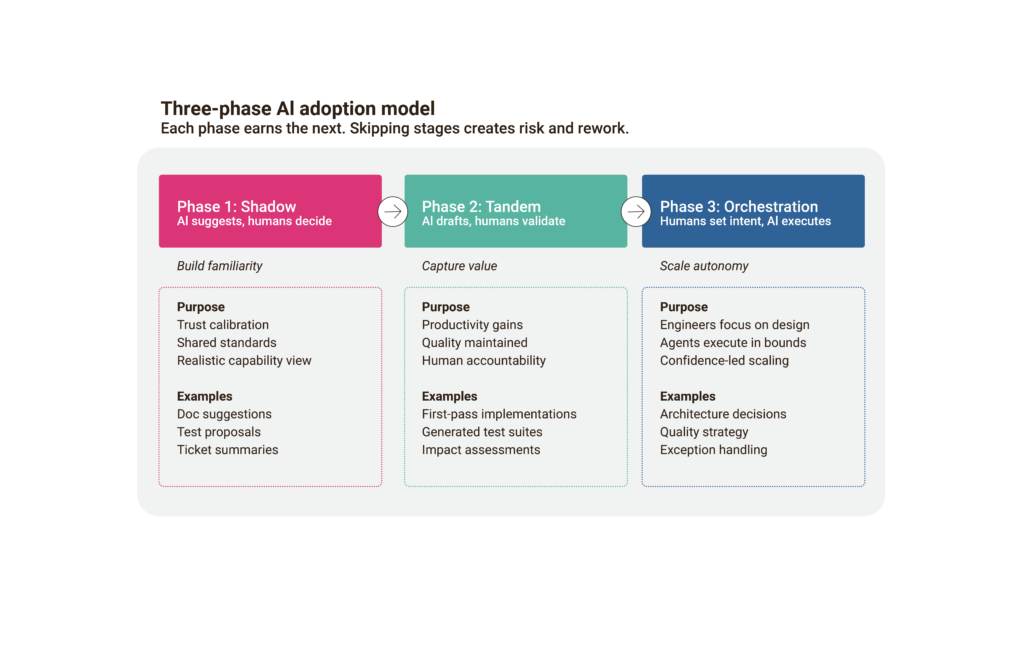
A practical adoption model should move through three phases: Shadow, Tandem and Orchestration. Each phase builds the trust, evidence and capability required for the next.
Phase 1: Shadow Mode
In Shadow Mode, AI suggests and humans decide. Agents may generate documentation, propose tests, suggest completions, summarise tickets or analyse parts of the codebase. However, humans remain fully responsible for the work and make every final decision.
The purpose of this phase is not productivity. It is familiarity. Engineers learn where AI is useful, where it fails and how much oversight is required. Leaders gain a more realistic view of the technology’s strengths and limitations. Teams begin building shared standards for acceptable use.
This phase is essential because it establishes trust without forcing behavioural change too quickly.
Phase 2: Tandem Mode
In Tandem Mode, AI drafts and humans validate. Agents take a more active role in producing first-pass implementations, test suites, documentation, pull request descriptions or impact assessments. Engineers review, refine and own the final outcome.
This is where meaningful productivity gains begin to appear, but the human remains firmly accountable. The team has enough experience to let AI do more, but not so much distance that understanding is lost.
Tandem Mode is often the most important phase for enterprise adoption. It allows organizations to capture value while maintaining quality, governance and engineering confidence.
Phase 3: Orchestration Mode
In Orchestration Mode, humans define intent, constraints and guardrails. Agents execute within those boundaries.
Engineers focus on architecture, system design, problem decomposition, quality strategy and exception handling. Agents contribute to implementation, testing, documentation and analysis where the team has confidence in the workflow.
This phase should only be reached when the organization has evidence that teams can evaluate agent output effectively. It should not be introduced because a roadmap says the organisation needs to be AI-native by a particular date.
Each phase earns the next. Skipping stages creates risk, resistance and rework.
The Teams That Win Stay Intact
There is a version of the AI-driven SDLC story that focuses entirely on tools, frameworks and productivity multipliers. That story is useful, but incomplete.
The more important story is about people.
It is about senior engineers questioning whether their craft still matters. It is about delivery leads trying to improve performance without unsettling teams that are already under pressure. It is about CTOs balancing board-level demand for AI adoption with the practical reality of complex systems, fragile processes and sceptical experts.
The organizations that lead in this next phase of software delivery will not simply be those that adopt AI fastest. They will be those that adopt AI without damaging the trust, culture and institutional knowledge that make software teams effective.
They will start with work that is safe, useful and easy to verify. They will build confidence before increasing autonomy. They will make AI contributions visible and reviewable. They will give engineers agency over how agents are introduced. They will measure outcomes that matter. They will treat adoption as a progression, not a mandate.
The future of software delivery is not AI versus engineers. It is AI plus engineers, supported by operating models that allow both to perform at their best.
AI will continue to improve. Agents will become more capable. Tooling will become more sophisticated. But none of that will create lasting transformation if the people using these systems lose trust in the process, the output or the intent behind adoption.
For senior technology leaders, the priority is clear. Do not simply add AI to the SDLC. Redesign the SDLC so AI can create value safely, transparently and sustainably.
That is where the real transformation begins.
Continue the Conversation
AI adoption across the SDLC is no longer a future consideration. It is already reshaping how modern engineering teams plan, build, test and release software. The challenge is making that shift in a way that improves delivery performance without increasing risk, weakening governance or losing the confidence of the people who understand your systems best.
To explore this topic in more detail, get in touch with gravity9 to discuss how we help organizations move towards an AI-augmented SDLC in a practical, phased and measurable way. You can also watch our webinar on AI in the SDLC and learn more about how senior technology teams are approaching adoption, trust and engineering transformation.