Hero Image

Integrate AI with Existing Systems

Build & Implementation

Connect AI Without Disruption

scroll down next block

Modernize the applications your business depends on without the risk

Legacy applications often sit at the heart of critical business operations, but over time they can become costly to maintain, difficult to scale and harder to adapt to new demands. The challenge is not simply replacing them, but evolving them in a way that protects continuity while creating a stronger foundation for growth.

Our Application Modernization and Migration offering helps organizations assess, modernize and migrate legacy applications using the right approach for each system. Whether that means data migration, service-layer refactoring or a full application rewrite, we focus on iterative modernization that delivers value early and reduces delivery risk.
Value

Legacy applications often limit agility, scalability, and integration. Modernization unlocks these constraints while preserving critical business knowledge embedded in existing systems.

Key benefits include:

  • Reduced technical debt and improved maintainability
  • Improved scalability and performance through modern architectures and data platforms
  • Greater flexibility to introduce new capabilities and integrations
  • Lower risk modernization through incremental delivery
  • Preservation of business logic while evolving underlying technology

This approach enables organizations to modernize at a pace aligned to business priorities and operational constraints.

Process

Depending on the application and objectives, modernization may include:

  • Data-first migration
    Migrating data from legacy platforms to modern data technologies (e.g. MongoDB or cloud-native data stores), while maintaining or gradually evolving application behaviour.
  • Service-layer refactoring
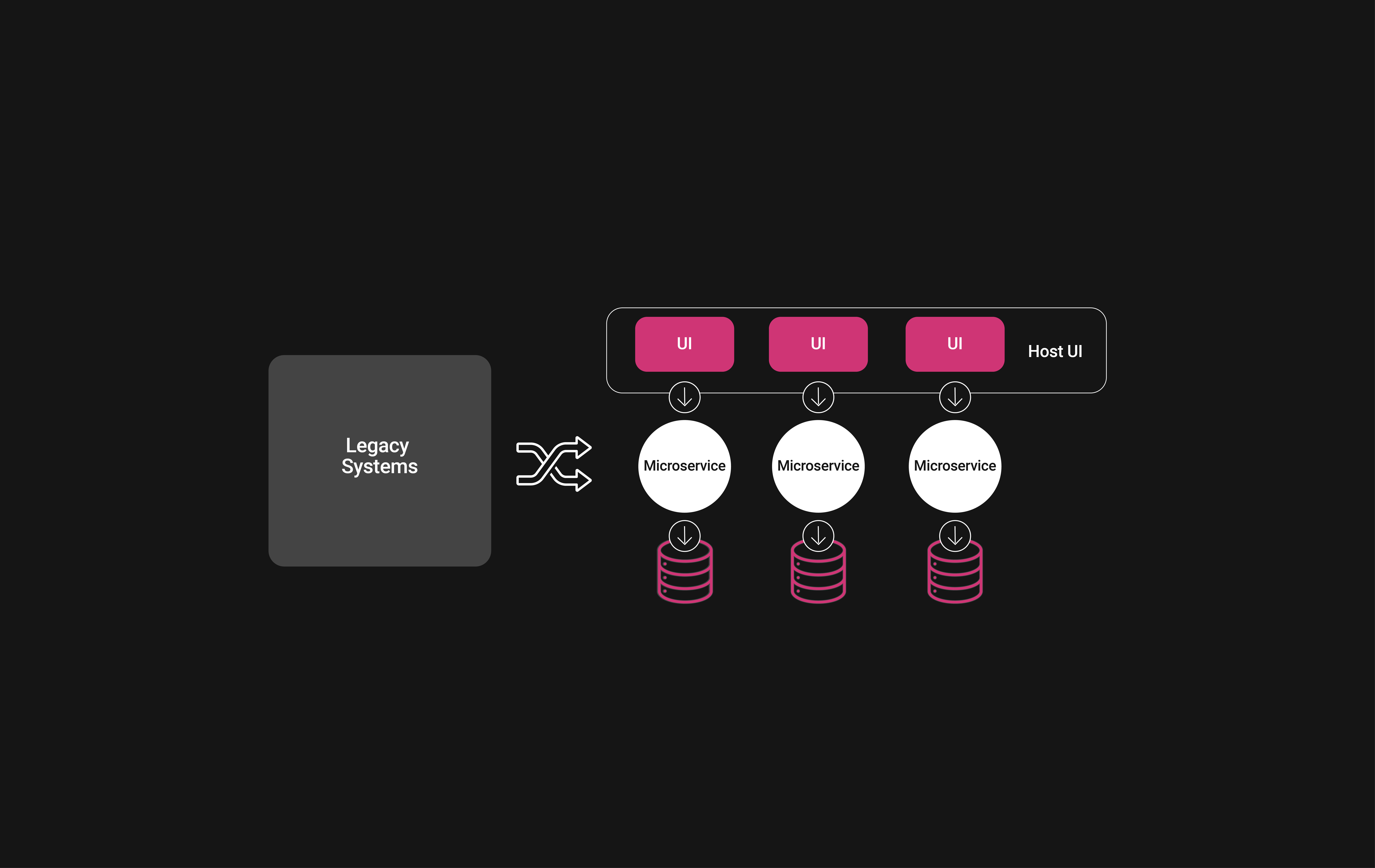
    Introducing a modern services layer that exposes business behaviour via APIs, allowing legacy applications to be progressively decoupled.
  • Application refactoring or rewrite
    Refactoring or fully rewriting applications onto a new technology stack where appropriate.


Iterative, Domain-Driven Approach

For large monolithic applications, we apply Domain-Driven Design (DDD) techniques to guide modernization:

  • Analyze the legacy application to identify sub-domains and bounded contexts
  • Decompose the monolith into well-defined components
  • Introduce independent services and data stores aligned to business capabilities
  • Gradually retire or replace legacy components as modern equivalents are introduced

This allows complex systems to be modernized in manageable, business-aligned increments.

Approach

Domain & Capability Analysis

Identify sub-domains, bounded contexts, and candidate components for extraction or migration.

Modernization Strategy Design

Define the appropriate mix of data migration, refactoring, and rewrite.


Incremental Implementation

Deliver modernized components iteratively alongside the existing system.


Data Migration & Validation

Migrate and validate data where required, ensuring continuity and integrity.


Transition & Decommissioning

Safely transition users and processes, retiring legacy components over time.

+ You Will Receive:

  • A clear modernization strategy aligned to business and technical goals
  • Assessment of which parts to migrate, refactor, or rewrite
  • An iterative delivery plan that reduces risk and disruption
  • Modern services and data platforms aligned to defined domains
  • Improved integration capabilities and extensibility
  • A technology foundation ready to support future digital and AI initiatives